
Research manuscripts designed for pixels, not paper
Write once in RSM. Share as an interactive web document. Export to PDF when journals require it.
Join the waitlistIntroducing Readable Science Markup (RSM)
A markup language designed for pixels, not the printing press
Your research lives online. Shared via links, read in browsers, discussed in Slack threads. But LaTeX forces you to design for printed pages, then export to PDF, then upload to a server.
RSM reverses this: design for web first, export to PDF only when journals require it. The same source file becomes an interactive document for colleagues and a traditional PDF for submission.
# Writing with RSM

Readable Science Markup is built with the full power of the modern web in mind. % Try resizing your browser or switching to dark mode.

:figure: {
  :label: fig1
  :path: fig1.html
}
:caption: You can embed interactive figures.
::

Write equations using LaTeX syntax. Display equations get automatic numbering.

$${:label: gaussian}
\int_{-\infty}^{\infty} e^{-x^2} dx = \sqrt{\pi}
$$

References such as :ref:fig1:: and :ref:gaussian,Eqn. (1):: appear as clickable tooltips.
RSM Studio
A collaborative editor for web-native manuscripts
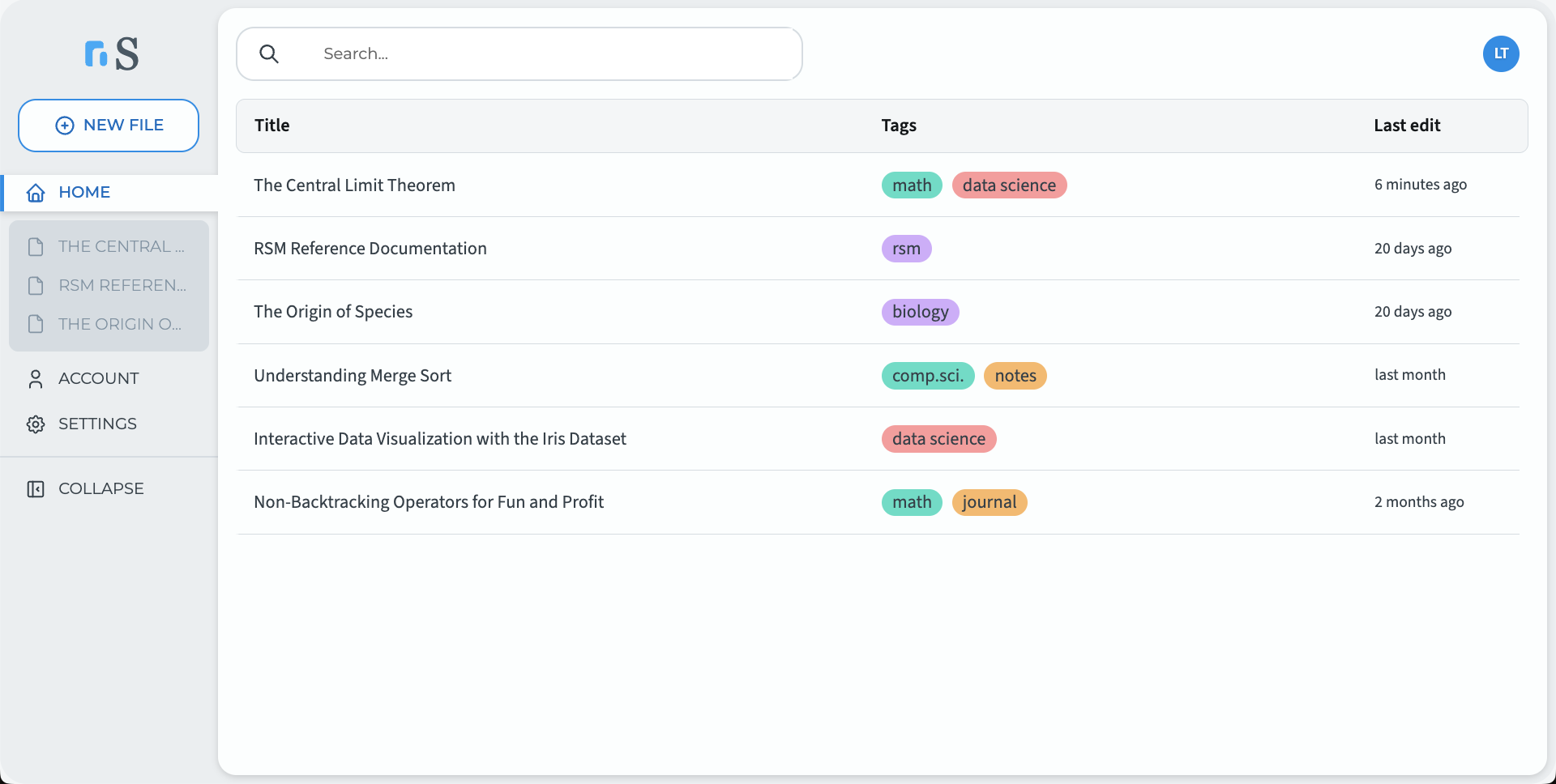
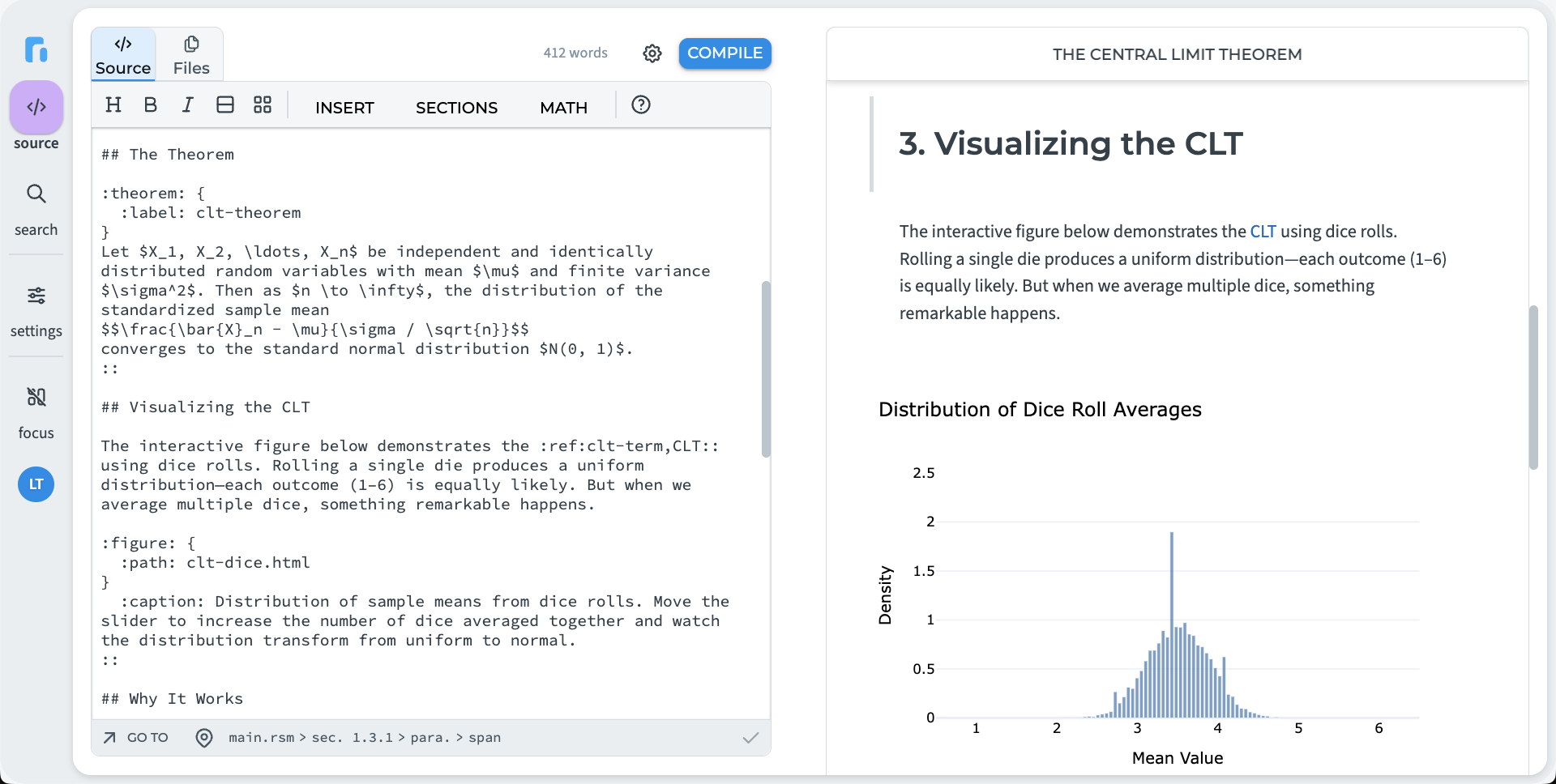
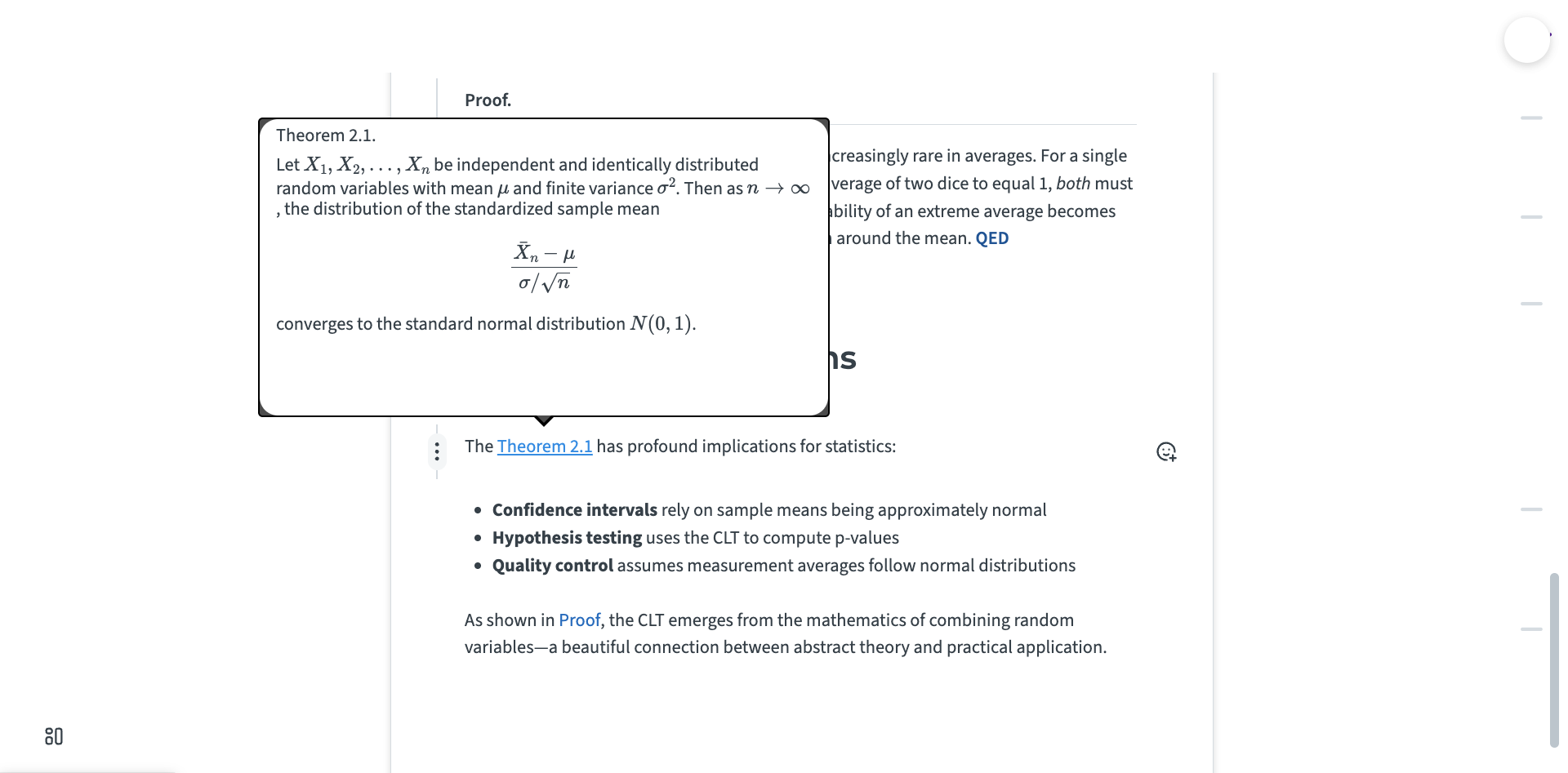
Find any manuscript instantly. Every draft auto-saved with full history. No more files lost to ancient email threads.
Be notified at launch
Coming mid 2026
Early signups help shape the product:
- Vote on features during beta
- Direct access to the founding team
- First to try new capabilities
Frequently Asked Questions
Web-native manuscripts are for your readers, not just journals. Most research is read online, shared via links, and accessed on phones and tablets. RSM lets you share living, accessible documents with colleagues while still exporting to PDF when journals require it. The same manuscript serves both audiences.
LaTeX was designed for print publishing in the 1980s. RSM is built for the web from day one, with responsive layouts, interactive elements, and accessibility features that work automatically without additional packages or configuration.
RSM is the only markup language built exclusively for web-native scientific publishing. Unlike Typst (designed for beautiful PDFs), Quarto (focused on computational notebooks), or MyST (built for technical documentation), RSM starts and ends with semantic web research documents. Complete separation of content and presentation means your manuscripts adapt to any reading context automatically.
RSM documents can export to traditional formats like PDF when needed for journal submission, while also offering modern web publishing options through platforms like Scroll Press.
Absolutely. RSM supports LaTeX-style math notation that renders beautifully on the web with proper accessibility support, including screen reader compatibility for mathematical expressions.
Yes! RSM Studio will include conversion tools to help migrate your existing LaTeX manuscripts, preserving your content while upgrading to web-native formatting.
We're targeting a mid 2026 launch with full registration open to all academic writers. Sign up above to be notified when we go live.
The Aris Program is our initiative to modernize academic publishing infrastructure, with RSM Studio as the flagship writing platform designed for the web era.
Want to try RSM today?
The command-line tools are open source. Install with pip install rsm and start writing.